

SS-31 Peptide (Elamipretide): The FDA Approval Most Pages Missed, and Why the Antioxidant Label Is Wrong
Almost every page describing the SS-31 peptide opens by calling it an investigational mitochondria-targeted antioxidant. Both halves of that phrase are now wrong, and they have been wrong for different lengths of time. The regulatory half broke on 19 September 2025, when the FDA approved elamipretide as FORZINITY. The mechanistic half broke in 2022, when a structure-activity study found the analogue with no radical-scavenging group at all was the most potent one in the series. I checked fourteen supplier and blog pages while writing this and found none that mentioned either.
Research-use-only disclaimer: SS-31 supplied as a research chemical is intended strictly for in-vitro and laboratory research use and is not intended for human or veterinary use. The clinical trial results described below concern an investigational, and now approved, prescription drug product administered under medical supervision. They do not describe or support any use of research-grade material. No dosing or administration guidance appears in this article; trial dose arms are reported as study design facts. Nothing here is medical advice.

TL;DR
SS-31 is the tetrapeptide D-Arg-Dmt-Lys-Phe-NH2, also called elamipretide. The FDA granted it accelerated approval on 19 September 2025 as FORZINITY, to improve muscle strength in Barth syndrome patients weighing at least 30 kg, on the basis of an open-label extension in 12 patients. It has never met a pre-specified primary endpoint in a randomised controlled trial across five indications. The FDA label calls it a mitochondrial cardiolipin binder and never uses the word antioxidant, and the structure-activity data agree: the analogue with no scavenging group was the most active. Three mechanistic models, cardiolipin binding, membrane surface charge, and a protein target called PLSCR3, are live and unreconciled. It is not a mitochondrial-derived peptide and grouping it with MOTS-c is a category error. Research use only.
Approved: FDA accelerated approval 19 September 2025, Barth syndrome only, United States only.
Trial record: Seven randomised trials, five indications, zero primary endpoints met.
Mechanism: Cardiolipin binder per the FDA label. Radical scavenging is dispensable per the 2022 SAR data.
Unresolved: Three competing models for the molecular target. No published synthesis.
Not an MDP: Contains a D-amino acid and dimethyltyrosine. No genome can encode it.
Confirmatory trial: 4TAZPOWER, n=48, final report due March 2030. The approval can be withdrawn.
Status: research use only.
What SS-31 Is, Chemically
SS-31 is a tetrapeptide: D-Arg-Dmt-Lys-Phe-NH2, where Dmt is 2,6-dimethyl-L-tyrosine. The FDA label gives the formal name as "L-Phenylalaninamide, D-arginyl-2,6-dimethyl-L-tyrosyl-L-lysyl-, hydrochloride (1:3)."[1] It is also called elamipretide, MTP-131 and Bendavia, the last two being Stealth BioTherapeutics' names for the early intravenous cardiology program. Szeto-Schiller 31 is where the SS designation comes from.
Two molecular weights circulate and they are not interchangeable. The free base, C32H49N9O5, is 639.8 g/mol. The approved drug substance is the trihydrochloride salt, and that is 749.2 g/mol.[1] The label uses 749.2 because that is what the vial contains. Supplier pages tend to quote 639.8 next to a milligram figure that came from a salt weight, which produces a quiet arithmetic error in anything downstream.
| Form | Formula | Molecular weight |
|---|---|---|
| Free base | C32H49N9O5 | 639.8 g/mol |
| Drug substance (trihydrochloride) | C32H49N9O5·3HCl | 749.2 g/mol |
The structure alternates basic and aromatic residues. D-Arg is basic, Dmt aromatic, Lys basic, Phe aromatic. Net charge is +3 at physiological pH, because the C-terminal amide removes the negative charge a free carboxylate would carry. The standard explanation for why a +3 peptide crosses membranes at all is that the aromatic rings shield the charge through their pi systems, giving enough lipophilicity for passive permeation.[2]
The register does not matter, which is a useful thing to know
Supplier copy often presents the basic-aromatic-basic-aromatic ordering as if it were the designed feature. The eLife structure-activity work tested that directly and found both orderings work. What matters is the composition, cationic plus aromatic, not the sequence in which they alternate.[3] The same study found the C-terminal amide is doing real work: it acts as a hydrogen bond donor that stabilises a reverse-turn conformation which enables membrane insertion. So the amide is load-bearing and the register is not.
Why the D-amino acid is there
D-Arg sits at position 1, the N-terminus, which is where aminopeptidases attack. The C-terminal amide blocks carboxypeptidases. The peptide is capped at both ends against exopeptidase degradation. The approved label's metabolism section is consistent with this: elamipretide degrades by sequential C-terminal cleavage to an inactive tripeptide (M1) and an inactive dipeptide (M2).[1] Degradation works inward from the unprotected end.
One flag. The comparative half-life figure for a D-Arg version against an all-L version circulates widely in supplier copy and I could not find a primary source for it. The protease-resistance rationale is sound and the label's metabolism data support the direction. The specific number does not have a citation I can point to.
This is not a mitochondrial-derived peptide
SS-31 gets grouped with MOTS-c and humanin under the heading "mitochondrial peptides." The three have almost nothing in common beyond the organelle.
| Origin | Length | Encoded where | |
|---|---|---|---|
| SS-31 | Fully synthetic | 4 residues | Nowhere. Contains a D-amino acid and 2,6-dimethyltyrosine, neither of which any genome can encode |
| MOTS-c | Mitochondrial-derived peptide | 16 residues | A 51-bp open reading frame inside the 12S rRNA region of mtDNA |
| Humanin | Mitochondrial-derived peptide | 21 or 24 residues | A 75-bp ORF in the 16S rRNA region of mtDNA |
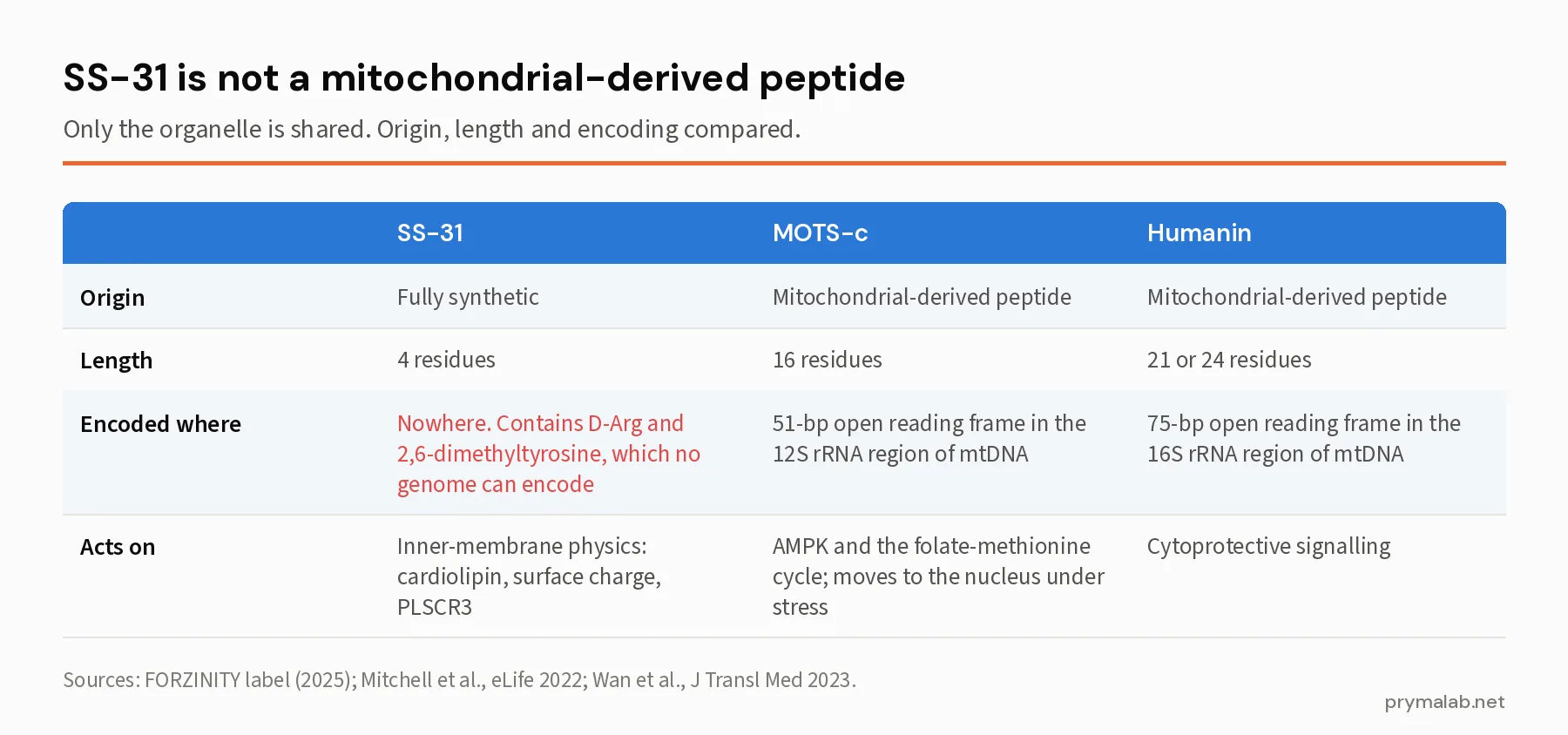
MOTS-c and humanin are endogenous signalling molecules. MOTS-c acts through AMPK and the folate-methionine cycle and translocates to the nucleus under metabolic stress.[4] SS-31 is an exogenous agent that acts on the physical properties of a membrane. If you are reading our MOTS-c reference alongside this one, the mechanisms are not parallel and the literatures do not transfer.
The Antioxidant Label Is the Wrong One
Here is the FDA's entire mechanism-of-action statement for FORZINITY:
FORZINITY is a mitochondrial cardiolipin binder that localizes to the inner mitochondrial membrane and improves mitochondrial morphology and function.[1]
No antioxidant. No free radical scavenger. No ROS quencher. A regulator writing a mechanism section has reviewed the sponsor's proposed language and the supporting data, and this is what survived that process.
The experiment that removed scavenging and got more activity
This is the strongest single piece of evidence on the question and I have not seen it cited on a single supplier page.
Dmt is the only residue in SS-31 with radical-scavenging capacity, via its phenolic hydroxyl. The eLife group built analogues that removed it. SS-20 substitutes Phe for Dmt. SPN10 substitutes Trp. Neither has a phenolic hydroxyl. Neither can scavenge.
SPN10, the compound with no scavenging moiety at all, showed "the strongest impact on most membrane properties" and the greatest efficacy in cell culture. All four peptides in the series bound cardiolipin-containing vesicles with essentially the same affinity, Kd between 27.5 and 39.5 micromolar, so affinity does not separate them. What separated them was binding density. SPN10 occupied 270 square angstroms per peptide against SS-20's 605.[3]
So the field has a controlled comparison showing the scavenging group is dispensable, published in 2022, and reviews in 2025 still carry "mitochondria-targeted antioxidant" in their titles. The nomenclature has not caught up with the data.
Cardiolipin, and What Binding It Actually Does
Cardiolipin is a four-acyl-chain, dianionic phospholipid found essentially only in the inner mitochondrial membrane. It carries two negative charges, which makes the inner membrane the most negatively charged membrane in the cell and therefore a thermodynamic sink for a +3 amphipathic peptide.
The cytochrome c switch
Cytochrome c has two jobs it can do, and which one it does depends on what it is bound to. Bound normally, it carries electrons. Bound to oxidised or peroxidised cardiolipin, it changes conformation and becomes a peroxidase, which then peroxidises more cardiolipin. That is an autocatalytic loop, and it destroys cristae architecture and initiates apoptosis.
Birk and colleagues showed SS-31 binds cardiolipin and that the resulting complex prevents cytochrome c from acting as a peroxidase while leaving its electron-carrier function intact. In rat renal ischemia, SS-31 pretreatment preserved cristae membranes, prevented mitochondrial swelling, and gave rapid ATP recovery on reperfusion.[5]
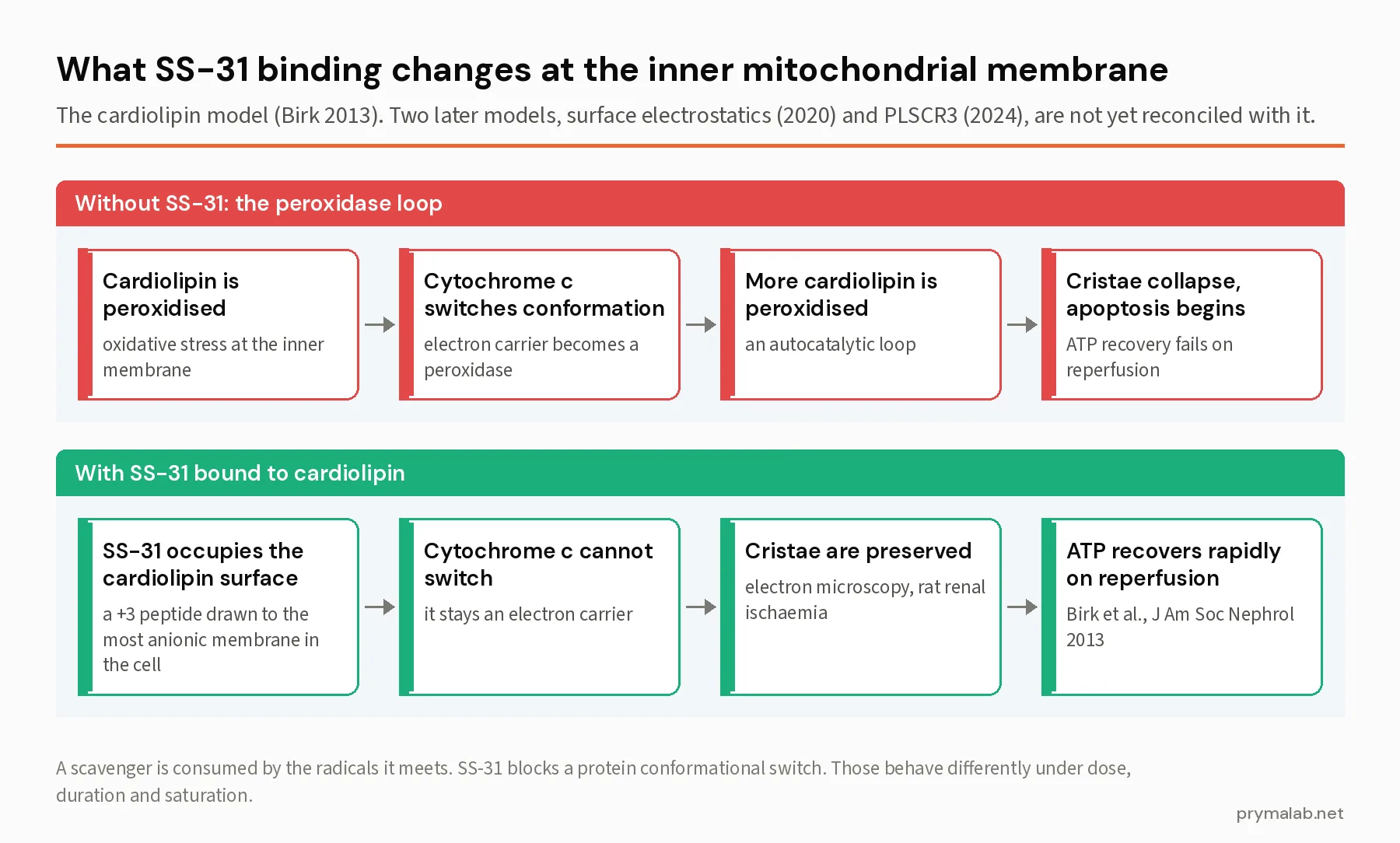
This is the distinction the antioxidant label erases. A scavenger is consumed stoichiometrically by the radicals it encounters. SS-31 occupies a lipid surface and blocks a protein conformational change. One is chemistry happening to the drug. The other is the drug preventing a machine from assembling. They behave differently under every condition that matters: dose-response, duration, saturation, and what happens when you run out.
The refinement almost nobody quotes
By 2020 the mechanism had moved again. A Journal of Biological Chemistry paper found SS-31 "partitions into the membrane interfacial region with an affinity and a lipid binding density that are directly related to surface charge," and modulates the surface electrostatics of both model and mitochondrial membranes.[6]
Binding tracks surface charge generally. It does not track cardiolipin specifically. Cardiolipin matters because it is the dominant anionic lipid of that membrane, so it dominates the charge. That is selectivity by physics, and it is a weaker and more interesting claim than the lock-and-key version that gets repeated.
The protein-level work is consistent with this. Cross-linking mass spectrometry identified SS-31's mitochondrial interactors and found they are all known cardiolipin binders, falling into two groups: oxidative phosphorylation proteins and 2-oxoglutarate metabolism proteins. The cross-linked residues sit near cardiolipin-protein interfaces.[7]
So SS-31 demonstrably sits at OXPHOS protein-lipid interfaces. Reviews take the next step and assert that it promotes respiratory supercomplex assembly and increases cristae curvature. I could not find a primary paper demonstrating increased supercomplex assembly by blue-native PAGE or cryo-electron tomography. Cristae preservation under ischemic stress is well supported by electron microscopy. Cristae curvature induction and supercomplex assembly are, as far as I can tell, inferred. Treat them as hypotheses.
The Third Model, and It Is Not a Lipid
In 2024 a genome-wide CRISPR screen proposed a protein target.
Plscr3 gene deletion completely abrogated the protective effects of SS-31 during cisplatin and rhabdomyolysis-associated AKI. Biochemical studies showed that SS-31 directly binds to a previously uncharacterized N-terminal domain and stimulates PLSCR3 scramblase activity.[8]
Completely abrogated. Not attenuated. If the protective effect of SS-31 were purely a bulk biophysical property of the membrane, knocking out one inner-membrane protein should not abolish it. PLSCR3 knockout alone did not change baseline kidney function or AKI severity, so this is not a sick-mouse artefact.
Two things about this paper matter for how much weight to put on it. Hazel Szeto is a co-author, so this is a refinement from inside the originating lab's network rather than an adversarial refutation. And a correction was published in the same journal later that year. I could not retrieve the correction's content, so I will say only that it exists.[9]
What you have now is three models that have not been reconciled with each other: a specific lipid, a generic surface property, and a specific protein. The 2020 electrostatics data say cardiolipin is not uniquely required. The 2024 CRISPR data say a lipid-only model is insufficient. Nobody has published the synthesis.
The Clinical Record, Including Every Miss
This is the part of the article that took longest to assemble, because the failures are distributed across fifteen years of trials in five unrelated indications and nobody has put them in one table.
| Trial | Indication | Phase | n | Primary endpoint | Result |
|---|---|---|---|---|---|
| EMBRACE-STEMI | Anterior STEMI | 2a | 118 | CK-MB AUC | Missed |
| PROGRESS-HF | HFrEF | 2 | 71 | Change in LVESV at 4 weeks | Missed |
| MMPOWER | Primary mitochondrial myopathy | 1/2 | 36 | 6-minute walk test | Missed (p=0.053) |
| MMPOWER-2 | Primary mitochondrial myopathy | 2 | 30 | 6-minute walk test | Missed (p=0.0833) |
| MMPOWER-3 | Primary mitochondrial myopathy | 3 | 218 | 6MWT + PMMSA fatigue | Missed, both |
| TAZPOWER (SPIBA-201) | Barth syndrome | 2/3 | 12 | 6MWT + BTHS-SA fatigue | Missed, both |
| ReCLAIM-2 | Geographic atrophy | 2 | 176 | LL-BCVA + √GA area | Missed, both |
| ReNEW | Dry AMD | 3 | 360 | EZ loss rate at week 48 | Ongoing, readout guided to late 2027 |
| NuPOWER | nDNA mitochondrial disease | 3 | not disclosed | not disclosed | Completed, results not publicly reported |
| 4TAZPOWER | Barth syndrome (confirmatory) | 4 | 48 | Knee extensor strength | Ongoing, final report due March 2030 |
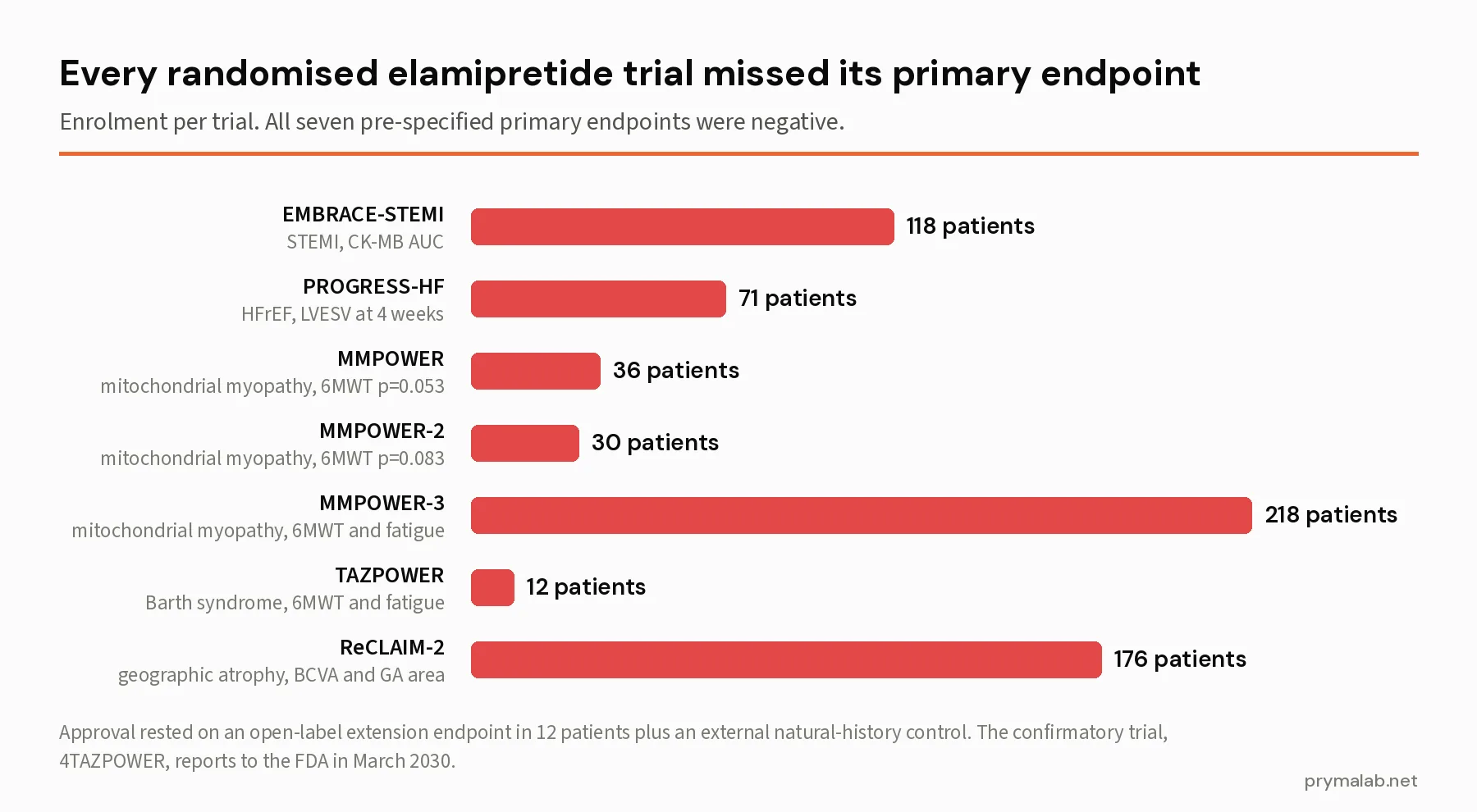
Elamipretide has never met a pre-specified primary endpoint in a randomised controlled trial. Across five indications and several hundred randomised patients, every co-primary and primary endpoint that was pre-specified came back negative.
MMPOWER-3, the definitive failure
218 patients randomised 1:1, 40 mg subcutaneously once daily for 24 weeks, co-primary endpoints of 6-minute walk distance and PMMSA Total Fatigue Score. The walk test difference was −3.2 metres (95% CI −18.7 to 12.3, p=0.69). Negative point estimate. The fatigue score came back at p=0.37. Every secondary endpoint was non-significant in favour of treatment. Adverse events were 98.2% on drug against 76.1% on placebo. The authors' own conclusion: "Subcutaneous elamipretide treatment did not improve outcomes in the 6MWT and PMMSA TFS in patients with PMM."[10]
The genotype subgroup, and why I would not build anything on it
A post hoc analysis split MMPOWER-3 by genotype and found the nuclear-DNA cohort (n=59, mainly POLG and TWNK) walked 25.2 ± 8.7 metres further than placebo, p=0.03. A narrower mtDNA-replisome plus CPEO subgroup of 32 patients showed +37.3 metres against −8.0, p=0.0024.[11]
Three things sit against reading much into this. The fatigue co-primary showed no differential effect between the genotype cohorts, so the signal appears in one endpoint and not the other. In the MT-TL1 carriers (n=49), placebo outperformed drug, +42.4 metres against +25.3. And it is a post hoc split of a failed trial in 32 people. The authors themselves wrote that basket designs "may induce insurmountable heterogeneity in rare disease clinical trials" and warranted only "cautious optimism."
NuPOWER was the prospective test of exactly this hypothesis. It has completed. Its topline has not been published. The only public characterisation is a May 2026 conference announcement describing "emerging evidence of genotype-dependent response in the POLG1 subgroup" and a plan for "a more targeted study in this genetically defined population."[12] That is the language a sponsor uses when a trial missed and a subgroup did not. I am reading tea leaves there and saying so.
How a Drug That Missed Every Primary Endpoint Got Approved
The Barth syndrome program is the one that worked, and understanding why requires reading the regulatory record rather than the press releases.
TAZPOWER randomised 12 male patients, ages 12 to 35, in a crossover design with 12 weeks per period. Both co-primary endpoints missed. What followed was a 192-week open-label extension, and in that extension, knee extensor muscle strength by handheld dynamometry rose from a baseline median of 124 newtons by a median of 34 N at week 12 and 63 N at week 168.[13] A separate study, SPIBA-001, compared those 12 treated patients against up to 19 propensity-score-matched natural history controls and reported more than 80 metres of mean 6MWT improvement against less than 1 metre.[14]
That package went to the FDA and the path took four years.
| Date | Event |
|---|---|
| 19 Aug 2021 | NDA 215244 submitted |
| 18 Oct 2021 | Refuse to file. FDA: the application "does not contain a single adequate and well controlled (AWC) trial that provides evidence of effectiveness" |
| 4 Aug 2022 | Type B meeting; FDA outlines an accelerated approval path |
| 3 Apr 2024 | Resubmission accepted for review |
| 10 Oct 2024 | Cardiovascular and Renal Drugs Advisory Committee meets; votes in favour |
| 15 May 2025 | Complete response letter. FDA declines approval, proposes accelerated approval instead |
| Aug 2025 | Third resubmission, reframed around knee extensor strength |
| 19 Sep 2025 | Accelerated approval |
The refuse-to-file letter is worth sitting with. The FDA said the randomised portion of the trial was negative and the open-label extension "remained uninterpretable due to lack of control and effort-dependent endpoints."[15] Four years later the drug was approved on an effort-dependent endpoint measured in an open-label setting. The endpoint changed from walk distance to knee extensor strength. The objection did not.
The vote was close. Trade coverage of the meeting reported it as 10 to 6 in favour; I could not open the FDA's own summary minutes to confirm the tally, so treat the exact split as reported rather than documented. What is documented is that the FDA's reviewers were sceptical. The clinical reviewer, Ann Punnoose, told the committee: "The FDA has difficulty attributing the findings to elamipretide because of significant limitations." The agency flagged selection bias and confounding in the natural-history control design and questioned the propensity score method.[16]
The confirmatory trial, 4TAZPOWER, dosed its first patient on 8 July 2026. 48 participants, 72 weeks, randomised double-blind placebo-controlled, final report due to the FDA in March 2030.[17] Accelerated approvals have been withdrawn on confirmatory failure before.
What the Approved Label Tells You That No Supplier Page Does
Before September 2025 there was no authoritative human pharmacokinetic dataset for SS-31. Now there is one, and it is more specific than anything in the research literature.
| Parameter | Value |
|---|---|
| Tmax (subcutaneous) | 0.5 to 1 hour |
| Absolute bioavailability (subcutaneous) | ~92% |
| Volume of distribution | ~0.5 L/kg |
| Plasma protein binding | ~39% |
| Metabolism | Sequential C-terminal degradation to M1 (tripeptide) and M2 (dipeptide), both inactive |
| Excretion | Renal; ~100% recovered in urine within 48 hours in normal renal function |
| Severe renal impairment (eGFR <30) | AUC +125%; M1 +280%; M2 +640% |
| QTc | No clinically significant prolongation at 3× the peak concentration seen at the highest labelled dose |
The adverse reaction table from the crossover study, 12 patients per arm, is blunt about tolerability. Any local administration reaction: 100% on drug against 67% on placebo. Injection site erythema 100% against 25%. Pain 75% against 42%. Induration 67% against 17%. Pruritus 67% against 17%.[1]
Two label items appear nowhere in the research-chemical literature. First, eosinophilia develops in studies running 30 days or longer, peaking around day 90 with a mean increase of 0.5 to 0.6 × 10³/µL, and resolves within 6 to 12 months either on continued exposure or after stopping. No clinical manifestations were observed, but it is a reproducible immune signal on chronic dosing. Second, the approved formulation contains benzyl alcohol at 20 mg/mL and carries a do-not-use-in-neonates warning for gasping syndrome, metabolic acidosis and neurotoxicity. Hypersensitivity reactions, including rash, papular lesions and eczematous dermatitis, have occurred anywhere from minutes to months after starting.
The Preclinical Aging Work, and the Parts That Get Left Out
The cardiac aging data are the strongest and most replicated preclinical finding in the SS-31 literature, and they are genuinely interesting.
In 24-month-old mice given 3 µg/g/day subcutaneously for 8 weeks, SS-31 increased the Ea/Aa ratio and decreased the myocardial performance index, reversing age-related diastolic decline. Age-related cardiac hypertrophy regressed. Treadmill running time increased significantly. Mitochondrial superoxide and hydrogen peroxide production fell, proton leak normalised, protein S-glutathionylation and carbonylation dropped, cMyBP-C Ser282 phosphorylation was restored, and p16/p19-positive senescent cells decreased.[18]
Then the part that gets cut from every summary I have read: the improvement in Ea/Aa "was maintained at 2 weeks, but dropped by approximately half at 4 weeks after treatment ceased." The effect is maintenance-dependent. It is not a reset.
In skeletal muscle, a single treatment restored in vivo mitochondrial energetics to young levels in aged mice within one hour.[19] The speed is itself an argument, because an hour is too fast for a transcriptional mechanism and about right for a direct biophysical effect on a membrane.
Two negative preclinical findings that belong in the same paragraph
In 24-month-old hypertensive mice, 10 mg/kg/day intraperitoneal SS-31 "did not significantly mitigate hypertension-induced CMH burden" in a cerebral microhemorrhage model.[20] A negative result in an aging model, published in 2025, from a group that works on cerebrovascular aging.
And there is a tumorigenesis signal. An independent review flags a liver cancer study in which mitochondria-targeted antioxidants including SS-31 facilitated tumorigenesis while non-targeted antioxidants prevented it, raising the concern that selectively protecting mitochondria could accelerate cancer growth.[21] The FDA has made two carcinogenicity studies, mouse and rat, a postmarketing requirement of the approval. Those studies have not reported.
How SS-31 Is Characterised
SS-31 is a short peptide with no methionine, no cysteine and no asparagine or glutamine, which removes the three most common storage degradation pathways. The 2,6-dimethyltyrosine residue is a non-standard amino acid, and non-standard residues are the ones that make characterisation harder, because reference standards are less available and mass assignment has fewer independent checks.
For any tetrapeptide, reversed-phase HPLC at 214 nm gives the purity figure and mass spectrometry confirms identity. Neither sees the counterions and residual water, which together make up a meaningful fraction of the vial mass. If you have not worked through why a vial labelled 10 mg at 99% purity does not contain 10 mg of peptide, that arithmetic is in our reference on peptide purity testing.
Handling notes that follow from the structure rather than from marketing: the peptide is capped at both termini, which makes it more stable than most in solution, but the trihydrochloride salt is hygroscopic and the usual rules apply. Our references on peptide storage and stability and reconstitution cover the general case. PrymaLab supplies SS-31 for laboratory research use with HPLC purity and mass spectrometry identity on every lot.
What This Article Does Not Settle
What the molecular target is. Cardiolipin binding, generalised surface-charge modulation, and PLSCR3 are three non-identical models. The 2020 electrostatics work says cardiolipin is not uniquely required. The 2024 CRISPR work says a lipid-only model cannot be complete. No published synthesis exists.
Why the preclinical results do not translate. Five indications, hundreds of randomised patients, zero primary endpoints met. Either mitochondrial dysfunction is not the rate-limiting lesion in these diseases, or the endpoints are insensitive, or the exposure and duration are wrong. The field has not determined which.
Whether supercomplex assembly increases. Asserted in reviews, supported by proximity data, not demonstrated directly by BN-PAGE or cryo-ET in anything I could find.
Whether the Barth approval survives. It rests on an open-label extension secondary endpoint in 12 patients plus an external control the FDA's reviewers criticised for selection and confounding bias. 4TAZPOWER reports in 2030.
The mitochondrial concentration figure. The "1,000 to 5,000-fold accumulation" number on most supplier pages, and the claim that uptake is membrane-potential-independent, I could not trace to a primary source. The related and verified finding is that these peptides do not change membrane potential, which is a different claim.
What is well established: the sequence and the two molecular weights, the FDA label's mechanism statement and pharmacokinetics, the complete primary-endpoint record, and the regulatory chronology. Those are checkable in the FDA documents.
Frequently Asked Questions
Is SS-31 the same thing as elamipretide?
Yes. SS-31, elamipretide, MTP-131 and Bendavia are one molecule, D-Arg-Dmt-Lys-Phe-NH2. FORZINITY is the FDA-approved brand.
Is SS-31 FDA approved?
Yes, since 19 September 2025, for Barth syndrome only, in the United States only. The approval is accelerated and conditional on a confirmatory trial due in 2030.
Is SS-31 an antioxidant?
The data say no. The FDA label calls it a cardiolipin binder, and the analogue with no scavenging group was the most active one in a controlled comparison.
What is the difference between SS-31 and MOTS-c?
MOTS-c is encoded in mitochondrial DNA and signals through AMPK. SS-31 is synthetic, contains a D-amino acid, and acts on membrane physics. Only the organelle is shared.
Has SS-31 ever succeeded in a clinical trial?
Not on a pre-specified primary endpoint. Seven randomised trials across five indications, all missed. Approval came from an open-label extension in 12 patients.
What is cardiolipin and why does it matter here?
A dianionic phospholipid unique to the inner mitochondrial membrane. Its charge is what attracts a +3 peptide, and its peroxidation is what flips cytochrome c into a peroxidase. SS-31 blocks that switch.
What did the PLSCR3 finding change?
It proposed a protein target. Deleting PLSCR3 abolished SS-31's protective effect entirely, which a pure membrane-physics model cannot explain. It has not been reconciled with the cardiolipin work.
Does SS-31 work orally or as a nasal spray?
No evidence for either. Every human study and the approved product used injection. The only topical program uses a different molecule.
What happened to Stealth BioTherapeutics?
It became Mighty Therapeutics in June 2026, launched FORZINITY commercially, raised up to $150 million, and is running the confirmatory trial.
What is the strongest preclinical result for SS-31?
Reversal of cardiac diastolic dysfunction in 24-month-old mice. The part usually omitted: the effect dropped by half within 4 weeks of stopping.
References
- FORZINITY (elamipretide) Prescribing Information, NDA 215244, and DailyMed listing. Mechanism statement, molecular weight, pharmacokinetics, adverse reactions and warnings. FDA label and DailyMed
- Tung C, Varzideh F, Farroni E, et al. Elamipretide: A Review of Its Structure, Mechanism of Action, and Therapeutic Potential. Int J Mol Sci. 2025;26(3):944. Charge-shielding explanation of membrane permeation. MDPI
- Mitchell W, Tamucci JD, Ng EL, et al. Structure-activity relationships of mitochondria-targeted tetrapeptide pharmacological compounds. eLife. 2022;11:e75531. The SS-20 and SPN10 analogues, binding affinities and densities, and the conclusion that scavenging is dispensable. eLife
- Wan W, Zhang L, Lin Y, et al. Mitochondria-derived peptide MOTS-c: effects and mechanisms related to stress, metabolism and aging. J Transl Med. 2023;21(1):36. Springer
- Birk AV, Liu S, Soong Y, et al. The mitochondrial-targeted compound SS-31 re-energizes ischemic mitochondria by interacting with cardiolipin. J Am Soc Nephrol. 2013;24(8):1250-61. PMID 23813215.
- Mitchell W, Ng EA, Tamucci JD, et al. The mitochondria-targeted peptide SS-31 binds lipid bilayers and modulates surface electrostatics as a key component of its mechanism of action. J Biol Chem. 2020;295(21):7452-7469.
- Chavez JD, Tang X, Campbell MD, et al. Mitochondrial protein interaction landscape of SS-31. Proc Natl Acad Sci USA. 2020;117(26):15363-15373. PNAS
- Silvaroli JA, Bisunke B, Kim JY, et al. Genome-Wide CRISPR Screen Identifies Phospholipid Scramblase 3 as the Biological Target of Mitoprotective Drug SS-31. J Am Soc Nephrol. 2024;35(6):681-695.
- Correction to the above. J Am Soc Nephrol. 2024;35(9):1295. PMID 38990651. Content not retrieved; existence verified.
- Karaa A, Bertini E, Carelli V, et al. Efficacy and Safety of Elamipretide in Individuals With Primary Mitochondrial Myopathy: The MMPOWER-3 Randomized Clinical Trial. Neurology. 2023;101(3):e238-e252. PMID 37268435. The 6MWT and fatigue co-primary results.
- Karaa A, et al. Genotype-specific effects of elamipretide in patients with primary mitochondrial myopathy: a post hoc analysis of the MMPOWER-3 trial. Orphanet J Rare Dis. 2024;19:431. Springer
- Stealth BioTherapeutics announcement of EUROMIT 2026 presentations, including the POLG1 subgroup language on NuPOWER. PR Newswire
- 168-Week Open-Label Extension Results of TAZPOWER. Genet Med. 2024. Knee extensor dynamometry and 6MWT in the extension cohort. Genetics in Medicine
- Stealth BioTherapeutics, SPIBA-001 natural history comparison results, 18 February 2020. The propensity-matched external control.
- FDA Administrative Correspondence for NDA 215244, including the 18 October 2021 refuse-to-file letter and meeting minutes. FDA. Complete response letter dated 15 May 2025: FDA action letters
- Fierce Biotech coverage of the Cardiovascular and Renal Drugs Advisory Committee, 10 October 2024, including reviewer and committee-member quotations and the reported vote. Fierce Biotech
- Mighty Therapeutics, first patient dosed in the Phase 4 confirmatory study 4TAZPOWER, 8 July 2026; FDA approval letter setting the March 2030 final-report milestone. FDA approval letter
- Chiao YA, Zhang H, Sweetwyne M, et al. Late-life restoration of mitochondrial function reverses cardiac dysfunction in old mice. eLife. 2020;9:e55513. eLife
- Siegel MP, Kruse SE, Percival JM, et al. Mitochondrial-targeted peptide rapidly improves mitochondrial energetics and skeletal muscle performance in aged mice. Aging Cell. 2013;12(5):763-71. PMID 23692570.
- Patai R, Patel K, Csik B, et al. Cerebral microhemorrhage model, negative result. GeroScience. 2025;47(3):4871-4887. Springer
- Alzheimer's Drug Discovery Foundation, Cognitive Vitality report on SS-31, 16 February 2021. Independent review including the tumorigenesis signal and earlier pharmacokinetics. ADDF
Trial figures are taken from published reports, FDA documents and sponsor announcements as cited, current to 13 September 2026. Where a figure could not be verified against a primary source, that is stated in the text. Regulatory positions described are United States federal decisions and should not be assumed to apply elsewhere.
Final disclaimer: This article is an educational research reference on the chemistry, mechanism and clinical trial record of elamipretide. Compounds supplied by PrymaLab are sold and studied for laboratory research use only and are not approved by any regulatory authority for human or veterinary use. Statements have not been evaluated by the FDA. Nothing here is medical advice, administration guidance, or a treatment claim.
The approved medicine FORZINITY is described for scientific and regulatory context only, and its inclusion does not describe or support any use of research-grade material. Trial dose arms are reported as study design facts. Always verify the legal status of any research compound in your jurisdiction before purchase or use.